
LinkedIn is undoubtedly the biggest networking site on the earth, having > 600 million subscribers. You need an effective and current LinkedIn profile if you are committed and passionate about your professional growth and development.
You can make a successful LinkedIn profile by following some important tips. You must keep your resume consistent with your LinkedIn description, upload a professional headshot, present your past work, add your relevant skills, and most importantly, you have to stay active for some time in a day to increase connections.
You can put your name and image in front of many businesspeople in your sector by creating a LinkedIn profile. And this is quite crucial if you are seeking work. However, more than simply having a LinkedIn profile is required.
You should have a great LinkedIn profile that stands out, conveys the proper messages, and enables you to interact with those who can advance your profession and career. So without wasting time, we should start our interesting topic.
What Is LinkedIn?
LinkedIn is a well-known social networking site that serves a specific function. Unlike other social media platforms like Facebook, Twitter, and WhatsApp, where the emphasis is primarily on your private affairs, LinkedIn is a professional networking site. This site is to create a network of connections to better your career.
Many companies are using LinkedIn to evaluate and hire new workers. Having a profile on LinkedIn might be beneficial while looking for a new job. After your account is activated, you join LinkedIn officially.
You must insert your required information and data to your profile page. This data is essentially an online CV and contains a brief overview of your talents, skills, and work experience.
You may add contacts or connections with additional LinkedIn members to expand your circle. You may ask for references, obtain talent approvals, and discover new career chances as you establish contacts.
You may also make friends and join groups devoted to particular businesses, sectors, and professionals. In addition to helping you locate others with similar career objectives and goals.
The benefit of joining these groups is that these groups keep informing you about the most recent developments in your industry.
Job-Search Feature
A robust job feature on LinkedIn may locate jobs all across the world. The next step is to categorize and filter these outcomes by business, amount of expertise, and other criteria. Additionally, some job vacancies provide quick and easy application features.
This feature enables you to quickly apply for a position by providing the details from your LinkedIn profile. LinkedIn may be a helpful job feature for everything from networking with coworkers to creating a good initial impact with recruiters.
Best Rated Full Service Real Estate Services Greater Toronto Area

Congratulations, registering for an account costs your email address and is free. LinkedIn may significantly influence your career life if you invest your time and effort to understand how to utilize it.
Common LinkedIn Terms
Connections, endorsement deals, and recruiters!
Several words on LinkedIn could be clearer if you are familiar with this site. Getting familiar with these terms is necessary before grasping how LinkedIn functions. You’ll get to know what to anticipate when you’ll start using this social networking site.
Profile
A profile is the primary element of a LinkedIn account. When someone searches for you on LinkedIn, your profile impresses the other person. Consider your profile to be a resume where you list your qualifications, education, and work experience.
You may also put extras like a profile photo and personal description that you would not put on a conventional resume.
Recruiter
A recruiter does hiring for a business. These persons may advertise your job opportunities and look for fresh prospects on LinkedIn. If your profile seems appropriate for an opportunity, these recruiters directly contact you.
Connections
Connecting with someone means joining someone on LinkedIn like you make friends on Facebook. Sending messages, seeing profile changes, and requesting suggestions are all made possible by connecting with other users.
Recommendation
A recommendation is a brief statement that can be seen on your profile, and that describes your work abilities and talents. Your contacts make recommendations, and you may request one if you like.
Endorsement
Your connections may attest to the abilities shown on your LinkedIn profile by giving them an endorsement. Your profile gains monitored when others recommend your talents, which may impress future hirers.
How To Create A Great LinkedIn Profile?
Don’t miss the following points while learning about creating your LinkedIn profile:
Don’t Imitate Your Resume
For each employment you apply for, resumes are often tailored. But your LinkedIn profile is global and addresses all future clients. While filling up your profile information, keep the description general and go into more detail about your abilities, projects, hobbies, and credentials inappropriate parts.
It might be advantageous to include work, references, and sponsorships. Consider that recruiter’s searches on LinkedIn prioritize profiles with the most information. Even if you are the top business expert in your area, if your profile doesn’t look good or complete, you’ll not be contacted for the position.
Although an excellent profile is one of many elements by which employers hire you, it plays a significant role in giving you the best job. So be sure to review every element of your profile that LinkedIn allows you to add and complete.
Don’t worry. You’ll be able enough to achieve so for each crucial component steadily.
Use A Professional Looking Photo
You’ll need more connections if you leave your profile photo section unattempted. You earn twenty-one times more views and 9x more connections with an attractive profile photo.
A perfect LinkedIn profile photograph should:
- Make the bulk of your screen your face
- Reflect a kind grin and temperament
- It should not show a flashy background
Which profile picture is appropriate? The idea is simple and professional yet approachable. Like your other social media profile photos, it must not be too informal. Please have a look at some pointers on how to choose the ideal profile photograph:
- Dressing to the nines is unnecessary, but you shouldn’t simply wear your go-to sweatshirt either. Observe the profile pictures of other members related to your profession, and choose an outfit that matches
- Ensure that you appear tidy and clean
- Try to be nice; avoid appearing severe or silly.
- Your face is highlighted in a profile photo. So, take a narrow rather than a full-body picture.
- Regardless of how fantastic you may appear in your school’s picture, your LinkedIn profile picture must be current.
- Low-quality photos should never be used.
- Wanna get noticed? You may. Use it if you have a great snapshot of yourself doing anything distinctive, like a fascinating pastime or another area of work-related. Keep remembering it must not be odd. If it’s not, it will draw attention in a good way. Because LinkedIn is a business platform
Write A Compelling Headline
A headline is a chance to demonstrate yourself instead of merely your doings. You may write a headline while keeping in mind the following:
- Does it reflect your career identity and highlight what makes you special?
- Does it reflect the concerns that an employer would have?
- What makes it clear at someone’s first glance?
It’s the main feature that an employer notices, so your headline is quite crucial. It must be brief, explicit, and precise in communicating your short intro. Given that many recruiters check by title, having the appropriate headline guarantees you are discovered for the proper and applicable position.
Please add your concise and appropriate career-related skills and abilities to the headline. To enhance your profile’s searches, try your best to use keywords so that people may easily find you.
For example, if you work as a software engineer for a Java company, don’t ever write ‘software engineer.’ Instead, use the ‘Java Developer’ phrase to make it attractive. Simultaneously, the use of detailed labels could be more feasible.
Create An Engaging Professional Summary
The greatest location for you to convey your business identity and personalize your expertise is the summary portion of your profile. It would be best if you added the following:
- 2 or 3 sentences introducing yourself
- 3-5 sentences describing your background, best qualities, and main interests
- 1-2 words describing your long-term objectives and the interaction with other group members
- Add a forty-word long summary to be in the search bar of recruiters
Spitting out the truth, the recruiters don’t have enough time to overview your profile from A to Z. They skim your headline and summary and swiftly evaluate whether you are eligible for the job.
Hence, it’s critical to have a good summary. A decent LinkedIn summary should have the following information:
- Experience in your present field
- Your most important and appropriate abilities must be mentioned. This often comprises technical skills, tools utilized, programming abilities, etc.
- Type of job you currently do
- Your noteworthy achievements and successes
- What are your interests?
- Mention the type of job you are searching for
Keep in mind the following tips while composing a summary on LinkedIn:
- Use short and straightforward phrases
- It must be 3-5 paragraphs long
- Separate the data into organized paragraphs
- Prefer using bullet points to make your summary readable
- Be explicit and try using figures of employees you supervised and the range of the funds you handled
How To Edit Interests On LinkedIn?
You can no longer manually add interests and hobbies on your profile. How would LinkedIn know your interests? There are three ways:
- Upon creation of your profile, LinkedIn would ask you to select your interests. You can consider following different organizations, companies or publications that you are interested in, and LinkedIn will start to suggest similar interests.
- Use the search box. Type the keywords that identify your interests, and LinkedIn will suggest you similar topics.
- Go to the organization’s LinkedIn profile page and click the “Follow” button. This will tell LinkedIn that you are interested in this organization, and it will suggest similar interests to you.
Highlight Your Experience
Your experience portion of your profile is the most crucial aspect. Experience is the most important component in determining your eligibility for a job. Check out the following pointers about your noticeable experience section:
- Include the tasks and accomplishments for each role
- Remove any unnecessary employment experience. If you are looking for a content writing job, remove your experience as a cashier private.
Putting your CV on a LinkedIn page isn’t enough. You can’t write pages here as you have online users with limited viewing time. Use 2-4 intriguing and outstanding points for each position you list.
Make sure to enter information which may give direction to your career. Use effective verbs to demonstrate your past achievements and your future plans for your career. The goal is to show your influence, the transformation you’ve brought about, the efforts you’ve spearheaded, and the outcomes you’ve produced.
Use Advanced Search Filters
You may find connections by entering:
- Name
- Recent or past employer
- Area
- Broad keywords associated with their job or function
Additionally, you may look for particular businesses and see if anyone in your surrounding can put you in touch with a contact there. Although it sounds apparent, it may occasionally be simple to let go.
There are three degrees to make connections (1st, 2nd, and 3rd) on LinkedIn require you to continue expanding your network as you make new friends. Having a large network keeps you accessible to people.
Yes, it is possible and easy to make connections with strangers. But it is better to connect with someone you know well, have had contact with, or interacted with professionally. Making a connection with a stranger needs a letter outlining your intro and intentions.
Customize Invitation Requests
You may include a personalized message to the invitation request to let the other person know why they should be added to your profile. The majority of LinkedIn users are often kind and helpful. But remember that you should make a satisfying relationship before requesting a job recommendation.
Send messages to your connections to learn further about your professional backgrounds through informative interviews or lunch dates.
Customize Profile URL
Your profile’s website address and hyperlink are your LinkedIn URLs.
- There is the number and your name at this address.
- You can make your URL brief and clean.
- It takes a few minutes to do so.
On the right side of your profile, there is an option to change and update your URL.
Check Out How To Create A Custom LinkedIn Profile URL:
Use Keywords
Do you want your profile to be in the search bar of recruiters? All sections of your profile, including the headline, summary, job experience, and skills, must be filled with the appropriate keywords.
Check out the websites that may check whether your profile is relevant to your work. If your job is related to content writing, then use the following keywords:
- Web content writing
- SEO copywriting
- Blogging
- Writing
- Social Media
Finding a job post most similar to the one you desire and scanning it for keywords is the best way.
Display Your Work/Projects
Have you ever designed any significant events? If you ever write any article, blog, or interesting topic, you can highlight them in your LinkedIn profile. Displaying your work or portfolio is necessary to gain experience in your related job.
Best Rated Full Service Real Estate Services Greater Toronto Area
You must have completed some school-related projects related to your degree, like IT; you may attach them to let recruiters see your amazing work. Create an area on LinkedIn to highlight your work. To accomplish this:
- Go to your LinkedIn profile
- Click on the ‘Add profile section’
- Choose ‘featured’
- Choose the content you wish to include
Another option to highlight your work is to include visuals in your experience diaries; it will make this section more notable, more beautiful and catch the recruiter’s attention.
Include All Of Your Relevant Licenses & Certifications
It would be best if you mentioned certificates that are extremely relevant to your work or career on your LinkedIn profile. Select ‘licenses and certificates’ from the ‘Add profile’ area to attach your certificates.
If you have some language certificates, don’t hesitate to add them. Whether it’s required or not, having an IELTS or language course has always been a positive point.
Fill In The Skills Section
The skills portion of your LinkedIn profile is extremely crucial. You may add a maximum of fifty talents to your profile, so don’t ever think about adding fewer talents. Add many as you can.
Include any talent you have, along with any analogues or variants such as content writing, copywriting, SEO writing etc. If you think of yourself as extra efficient, having more than fifty talents and abilities, be sure to include only those most important.
Or you can only include that that comes to your mind; LinkedIn may suggest the equivalent ones. As soon as you complete this step, it’s time to move further to secure some endorsements.
Ask your current and former employees to recommend your abilities on LinkedIn by getting in touch with them. You’ll recommend them, too, as a way of saying thanks.
This is quite crucial because recommendations serve as social verification. They will help you become a more conventionally attractive applicant, though they won’t be the deciding factor in the recruiter’s demand to hire you or not.
A recruiter has little need for generalized soft skill claims like being friendly, a team player, and having logical thinking abilities. These skills are incredibly used and applicable to the majority of individuals to some degree.
No one asks for your soft skills. Your hard skills matter a lot that might be helpful during an interview. A recruiter decides whether to choose you for a job according to your hard skills.
Be Active
Send messages to your contacts, seek interview sessions, search for references and recommendations, and interact with the related material. Post, remark, and share content that your connection may find interesting in order to be seen by other experts on LinkedIn.
Additionally, you may make friends and join groups to interact with the people in your field and share ideas. However, this does not imply that you must spend the entirety of your day here. You only need to spend 10-20 minutes daily on it to succeed.
Request Recommendations
This is a major concern. Consider the individuals with whom you have previously created successful professional relationships. You can click on ‘add recommendations’ while editing your profile.
You can select individuals from your relationships and recommendations you want to receive. Send it, and wait for the positive comments. Your LinkedIn profile lookout depends heavily on recommendations.
Clients want your praised work in the history so that there is no way to deny you as their next worker. Encourage some of your friends to submit recommendations as payment to your reputation out.
On LinkedIn, recommendations are comparable to references from individuals. You may ask your coworkers, tutors, advisors, recruiters, and recent or past supervisors for suggestions.
Recommendations provide engaging content to your profile since they demonstrate that your colleagues and employees are impressed with your abilities. You can acquire the greatest, most useful advice from your immediate management.
The next best recommendations come from consumers or companies you have dealt with. These clients are actually really pleased and grateful for the service you accomplished for them.
The third recommendation includes your crosswise linked colleagues. It is from group members with whom you worked closely and for a long span, hence their feedback about you will be more valuable.
Follow Companies
You may follow businesses on LinkedIn that you are interested in, and you may make job notifications to be sent regularly using a mixture of keywords and criteria. You may locate jobs using LinkedIn filters by entering keywords, job title, business name, work locations, job functions, experience levels, and dates.
Check Your LinkedIn Profile Strength
There is a feature on the right side of your profile that measures your profile strength. In essence, this informs you how well you have completed your profile. It is quite easy and helps you identify if you either neglected something.
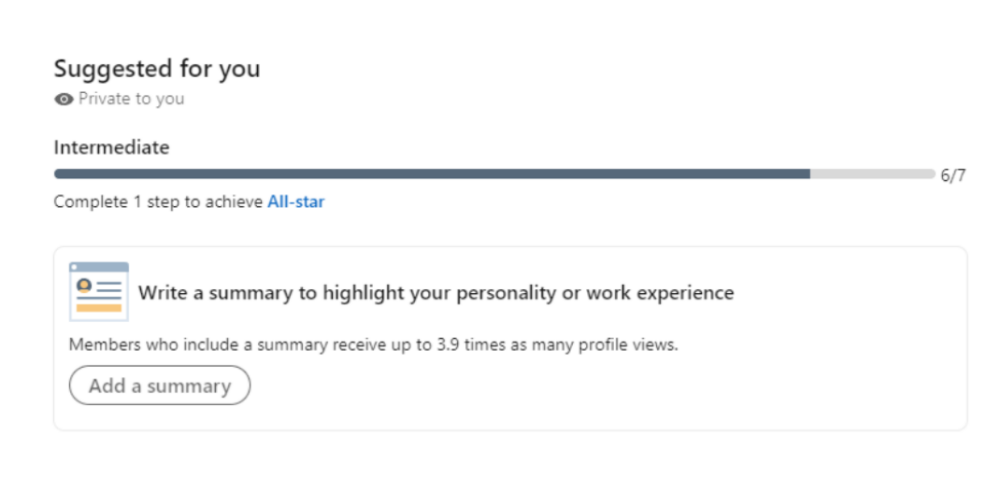
Change according to the suggestions and add or remove information accordingly. A strong platform that is also very simple to utilize and benefit from is LinkedIn. Utilize it to the fullest by customizing your profile to be notable among the competition, market your abilities, and support your success.
Show That You’re Open to New Opportunities
You may indicate and attach a label of ‘open to work’ to your profile picture. This shows that you are open to new opportunities. This aids recruiters in determining that you are really amenable to being contacted.
Apply Actively
To rapidly look for a job you desire, click the ‘easy apply’ option. Or you may also apply at the company website. You can identify several job opportunities on a laptop or a LinkedIn app on mobile.
Focus on Recent Job Postings
Your chances of landing a job increase by 13% if you apply for it within the initial (1st three) days of the position being hosted. As you start your job hunt in Canada, polishing your profile and remaining active on LinkedIn may help you stand out to the clients.
FAQs
What Is The Best Feature Of LinkedIn?
To maintain its position as the preferred network for hiring managers and job searchers, LinkedIn is continuously adding new features. It has released many features over the past months that might assist its users in connecting with a larger network and making an impact.
Since video articles are circulated twenty times more than any other type of content, it is now an important priority of LinkedIn. To help you remain on top of the competition, we have included a rundown of all the latest LinkedIn features:
– LinkedIn cover story
– Live videos
– Newsletter for company pages
– Reposting directly on LinkedIn
– LinkedIn creator mode
– Anonymous Browsing
– LinkedIn polls
– Merge accounts
– Reactions
– Dark mode
– Name pronunciations
– Photo frames with the tag’ open to working’ or ‘hiring’
– Video meetings
– LinkedIn events
– Save posts to ‘my items’
– Edit messages after sending them
What Should I Write For LinkedIn Example?
You probably need to put a writing summary for a profile on priority. Your profile is sufficient if it has a photo and a title. Since your organization currently gets many excellent people, it hardly values your effort.
But you need an outstanding example to understand the power of a summary and learn how to craft it for yourself. Read an example below:
You want to list your major professional accomplishments and significant experiences in a bulleted list:
The following characteristics can make you, SVP and creative director, unique:
– Cite your biggest successes as the first point
– Relate the beginning of your profession with a tale
– Reveal a sensitive fact (your spouse has cancer) to increase your reliability in drug advertisements
– Give a brief description of your position
You must add this phrase, I enjoy promoting products, and I wouldn’t say I like self-promotion. This can enhance job opportunities.
What Color Is Best To Wear For Headshots?
The choice of colour to match your appearance, business, or both is crucial in making the ideal headshot. The right selection of colour may give you a leaner, more assertive, sympathetic, reliable, and frequently more accessible appearance.
Read on to learn how to make the most of colour perceptions and combinations in your headshot:
Neutral or solid colours! Because they are easy on the eye and have little danger of overpowering the frame, solid and neutral colours usually perform effectively. For example, white and cream colours.
Neutrals have no hard deadlines, don’t compete, and don’t have feelings. They complement most other shades, so you may use them for a light and subtle effect. Neutrals may be used to emphasize a look to grin.
What Are The Disadvantages Of LinkedIn?
The following are the disadvantages of LinkedIn:
Identity Theft Danger
You have to provide a ton of personal details for the eyes of potential employers. Therefore, if LinkedIn servers have a problem, you risk losing sensitive details to the audience, which might lead to identity danger.
Best Rated Full Service Real Estate Services Greater Toronto Area
Unfinished Profile Problem
LinkedIn requires you to create a visually appealing profile like other social networking services. Potential entrepreneurs and recruiters may find this profile intriguing. So, it’s difficult for some people to complete the profile information.
It Takes Time
The time factor is LinkedIn’s main flaw and turnoff. The period of hours required before your find an effective grip on its utilization. In contrast to other websites, using LinkedIn effectively requires you to be prepared to sacrifice your valuable time each day.
Numerous Spam Emails
Consider the number of posts that will be accessible on a site with more than 1200 million users. LinkedIn has great spam communication from recruiters, businesses, and even job applicants. All merely a deception to attract attention, deceive, and demand money.
A Premium Bundle Might Be Pricey
You may sign up on your LinkedIn account, but its premium packages aren’t free. For instance, the monthly cost for a mild career is around $30. Although this deal has severe additional advantages, it might still be highly expensive for a small or mild organization.
Conclusion
Entrepreneurs from all across the world may find success on LinkedIn. It is a go-to place for professionals from all walks of life. Job applicants, specialists, employers, CEOs, and tutors are finding great opportunities here.
By promoting professional contact, LinkedIn has helped its all subscribers relax the rigidity of the commercial environment. The majority of LinkedIn features are geared around protecting your data, helping to save time, growing your network, and advancing your professional objectives.
We understand that it is not a fast process, but your patience must bring fruit. You have to keep patience until greater opportunities for jobs come your way. Let us know on OnTheMoveCanada if you find any issue that needs to be solved regarding this guide. Stay active, and best wishes with your career!