
States That Border Canada
Thirteen US states border Canada. Eleven of them share a land or bridged-water boundary you can drive across; two more (Ohio and Pennsylvania) only meet Canada through Lake Erie, with no crossing of their own. Together those 13 states sit along the longest international border on the planet: 8,891 kilometres, or 5,525 miles, from the Bay of Fundy to the Beaufort Sea.
If you arrived here trying to settle a trivia question, the short answer is below. If you’re planning a move, a road trip, or a cross-border life, this guide gives you each state’s border length, the Canadian provinces or territories it touches, the main crossings, and the practical detail that matters when you actually cross.
Key Takeaways
- Thirteen US states border Canada: Alaska, Washington, Idaho, Montana, North Dakota, Minnesota, Michigan, Ohio, Pennsylvania, New York, Vermont, New Hampshire, and Maine.
- The full Canada-US border runs 8,891 km (5,525 mi). Alaska alone accounts for 2,475 km (1,538 mi) of it; the Lower 48 share the remaining 6,416 km (3,987 mi).
- Ohio and Pennsylvania border Canada only across Lake Erie. Neither state has a road crossing into Canada.
- There are 119 legal land border crossings in total, plus a handful of ferries on both coasts and the Great Lakes.
- The land border is marked by a six-metre (20-foot) cleared strip called the Vista, maintained continuously by the International Boundary Commission.
How Many States Border Canada?
Thirteen. The list, west to east, is Alaska, Washington, Idaho, Montana, North Dakota, Minnesota, Michigan, Ohio, Pennsylvania, New York, Vermont, New Hampshire, and Maine.
Two of those thirteen are technical inclusions worth flagging. Ohio and Pennsylvania share their international boundary entirely across the open water of Lake Erie. The line is real, the boundary is enforced, and the lake is policed by both the US Coast Guard and the Royal Canadian Mounted Police marine units. But neither Ohio nor Pennsylvania has a bridge, tunnel, or land crossing into Canada. To drive into Ontario from Cleveland or Erie, you go through Buffalo, Detroit, or Port Huron.
Michigan is the inverse case. Most of Michigan’s “border” is also water (Lake Superior, Lake Huron, the St. Marys River, the St. Clair River, the Detroit River, and Lake Erie), but it has four bridges and tunnels that carry road traffic into Ontario every day. Geographers count Michigan as a water boundary; drivers treat it as a land border.
This guide treats all 13 states as bordering Canada, then notes how each border is actually crossed.
The Canada-US Border, in Numbers
| Stat | Figure |
|---|---|
| Total length | 8,891 km / 5,525 mi |
| Length, Lower 48 + Canada | 6,416 km / 3,987 mi |
| Length, Alaska + Canada | 2,475 km / 1,538 mi |
| US states bordering Canada | 13 |
| Canadian provinces and territories bordering the US | 8 |
| Legal land border crossings | 119 |
| The “Vista” (cleared strip width) | 6 m / 20 ft |
| Boundary monuments and reference points maintained | 8,000+ |
The figures come from the International Boundary Commission, the joint US-Canada body that has maintained the boundary since the 1925 Treaty. The Commission re-walks the entire line on a rolling basis, replaces damaged monuments, and keeps the six-meter Vista clear of trees and brush so the boundary remains physically visible.
The eight Canadian provinces and territories on the other side, west to east, are Yukon, British Columbia, Alberta, Saskatchewan, Manitoba, Ontario, Quebec, and New Brunswick. The four Atlantic provinces of Newfoundland and Labrador, Prince Edward Island, Nova Scotia, plus the territories of Northwest Territories and Nunavut, do not touch the contiguous border.
All 13 States That Border Canada, Ranked by Border Length
The states below are ranked from longest border to shortest. State-by-state lengths track the WorldAtlas compilation of US Census and IBC data; crossing counts come from the International Boundary Commission and US Customs and Border Protection.
1. Alaska: 1,538 mi (2,475 km)
Alaska shares more border with Canada than the other 12 states combined. The line runs north along the 141st meridian for most of its length, then jogs east along the Alaska Panhandle to meet the Pacific. On the Canadian side, Alaska borders Yukon and British Columbia.
There are five road crossings, all remote. Alcan/Beaver Creek (on the Alaska Highway) is the most-used and the only 24-hour port. Poker Creek-Little Gold Creek, on the Top of the World Highway between Dawson City and Chicken, is North America’s northernmost land border crossing and operates seasonally from mid-May to mid-September. Ferry travel matters here too: the Alaska Marine Highway System connects Ketchikan, Juneau, and Haines to Prince Rupert, BC.
If you’re moving to Canada from Alaska or vice versa, the practical reality is that almost every overland trip passes through Yukon or northern BC. Plan for fuel stops, satellite coverage, and seasonal closures.
2. Michigan: 721 mi (1,160 km)
Michigan’s border is entirely water on paper, which makes it the longest “water” border with Canada. In practice, four major fixed crossings handle most of the road traffic between the US Midwest and Ontario:
- Ambassador Bridge (Detroit-Windsor): the busiest commercial crossing in North America by trade volume.
- Detroit-Windsor Tunnel: the second-busiest passenger crossing on the border.
- Blue Water Bridge (Port Huron-Sarnia): the main I-94/Highway 402 truck route.
- Sault Ste. Marie International Bridge: links the two Saults across the St. Marys River.
The new Gordie Howe International Bridge opened in 2025 alongside the Ambassador, doubling cross-river capacity at Detroit-Windsor and giving freight a direct interstate-to-highway connection without local-street routing.
3. Maine: 611 mi (983 km)
Maine has 24 land border crossings with Canada, more than any other state. The border touches Quebec to the west and New Brunswick to the east, with the St. John River forming much of the eastern line. The boundary’s modern form was set by the 1842 Webster-Ashburton Treaty, which ended the brief and largely bloodless Aroostook War.
The busiest crossings are Houlton-Woodstock on I-95, Calais-St. Stephen on US-1, and Madawaska-Edmundston on US-1 in the Saint John Valley. The smaller and more rural crossings, such as Coburn Gore and Forest City, often run on reduced hours and may close overnight or seasonally.
For Maine residents, the practical border is closer than Boston for most of the state. Day trips to the Bay of Fundy, Saint John, or Quebec’s Eastern Townships are routine.
4. Minnesota: 547 mi (880 km)
Minnesota’s border runs through Manitoba to the west and Ontario to the east. The boundary follows the Pigeon River, the chain of lakes through Voyageurs National Park, the famously straight 49th parallel across the prairie, and the unique Northwest Angle: a small piece of Minnesota that is only reachable from the rest of the US through Manitoba or by boat across Lake of the Woods.
Eight designated crossings serve the state, including International Falls-Fort Frances, Pigeon River-Grand Portage, and Roseau-Sprague. The Northwest Angle has its own video-supervised reporting station for boaters.
5. Montana: 545 mi (877 km)
Montana borders three Canadian provinces (British Columbia, Alberta, Saskatchewan), more than any other state except Alaska. There are 13 to 14 active crossings depending on seasonal status. Sweet Grass-Coutts on I-15 is the major commercial port and the busiest by volume; Roosville on US-93 carries most BC-bound traffic.
Waterton-Glacier International Peace Park, straddling the Montana-Alberta border, became the world’s first International Peace Park in 1932 and remains a UNESCO World Heritage Site. Chief Mountain crossing, inside the Peace Park, is open seasonally and worth the detour.
6. New York: 445 mi (716 km)
New York has more cross-border road and rail traffic than any state other than Michigan. The border runs through both Ontario and Quebec and includes the St. Lawrence River corridor, Lake Ontario, the Niagara River, and the Adirondacks-to-Quebec stretch.
The four Niagara Falls bridges (Peace Bridge, Rainbow Bridge, Whirlpool Bridge, Lewiston-Queenston) plus the Thousand Islands Bridge and Champlain-Lacolle handle the bulk of the volume. There are 16 to 17 crossings overall. Amtrak’s Maple Leaf and Adirondack trains both cross here, with the Adirondack ending in Montreal.
7. Washington: 427 mi (687 km)
Washington’s border is the cleanest line in the country: the 49th parallel, surveyed in the 1860s, with the Peace Arch marking the I-5 crossing at Blaine-Surrey. Thirteen crossings serve the state, including Sumas-Abbotsford, Lynden-Aldergrove, and Point Roberts.
Point Roberts is the geographic curiosity here: an American exclave on the southern tip of the Tsawwassen Peninsula, accessible by land only through British Columbia. Roughly 1,300 US citizens live there, and the BC border crossing is effectively their only road in or out.
Ferry options are strong on this coast: Washington State Ferries runs Anacortes to Sidney, BC, the Black Ball Ferry runs Port Angeles to Victoria, and Clipper runs a foot-passenger fast ferry from Seattle to Victoria.
8. North Dakota: 310 mi (499 km)
North Dakota has 18 designated crossings, the second-most after Maine. The state borders Saskatchewan and Manitoba, and most of its line follows the 49th parallel. Pembina-Emerson on I-29 is the major commercial port.
The crossings here trend small and rural. The famous International Peace Garden, straddling the border between Dunseith, ND and Boissevain, MB, is itself a pre-clearance area: visitors entering the garden re-enter their home country on exit, no passport needed inside.
9. Ohio: 146 mi (235 km)
Ohio’s full border with Canada sits in the open water of Lake Erie. There are no road crossings from Ohio to Ontario. To drive into Canada from Cleveland or Toledo, the closest options are the Detroit crossings to the west or the Buffalo-area crossings to the east.
Pelee Island ferry service, run by the Ontario government, connects Sandusky, OH to Pelee Island and on to Leamington and Kingsville, ON during the navigation season (typically April through December). It’s the only direct Ohio-to-Ontario passenger route.
10. Vermont: 90 mi (145 km)
Vermont borders Quebec along a short, surveyed line that runs east from Lake Champlain to the New Hampshire state line. There are 15 crossings, more than the state’s modest length suggests, because much of the rural Eastern Townships infrastructure crosses here.
Highgate Springs-St. Armand on I-89 is the main port of entry for Burlington-to-Montreal traffic, a roughly 90-minute drive on either side. Derby Line-Stanstead is the cultural curiosity: the Haskell Free Library and Opera House sits directly on the international boundary, with the audience in the US and the stage in Canada.
11. New Hampshire: 58 mi (93 km)
New Hampshire has only one road crossing into Canada: Pittsburg-Chartierville (US-3 to Quebec Route 257), at the very northern tip of the state. The border runs through the Connecticut Lakes region and the headwaters of the Connecticut River, in country that is almost entirely forested.
For most of New Hampshire’s population, the closest crossing to Canada is actually in Vermont or Maine. The Pittsburg crossing is a regional and recreational route rather than a commuter or commercial one.
12. Idaho: 45 mi (72 km)
Idaho’s stretch is the second-shortest land border, just 45 miles of north-Idaho panhandle meeting British Columbia. There are two crossings: Eastport-Kingsgate on US-95, the main route between Spokane and the Kootenays, and Porthill-Rykerts on Idaho-1, a smaller rural port.
Eastport-Kingsgate runs 24 hours and handles most of the traffic. If you’re driving from Coeur d’Alene to Cranbrook, this is your route.
13. Pennsylvania: 42 mi (68 km)
Pennsylvania has the shortest international border with Canada. Like Ohio, it’s all Lake Erie water. There is no road crossing from Pennsylvania to Ontario. To drive north, Pennsylvanians use the Buffalo-area crossings (Peace Bridge or Lewiston-Queenston) about 90 minutes from Erie.
That makes Pennsylvania the only state where the official border length is essentially trivia. It exists, the line is on the chart, and ships passing through it are subject to both countries’ rules. But for travellers, it’s a border in name only.
Land Borders vs. Water Borders: What Actually Counts
The 13-state list is sometimes given as 11, sometimes as 13, depending on what counts. The split:
- Land border (no water): Alaska, Washington, Idaho, Montana, North Dakota, Vermont, New Hampshire, Maine, and most of Minnesota. The border on these stretches is dirt, forest, monument-marked terrain, with the cleared Vista visible from the air.
- Mixed land-and-water border with road crossings: Michigan, New York, and parts of Minnesota and Maine. The international line runs through rivers, lakes, or straits, but bridges or tunnels carry road traffic across.
- Water-only border with no road crossing: Ohio and Pennsylvania. The line runs through Lake Erie, and the only ways across from these states are by ferry (Sandusky-Pelee Island), private boat with appropriate clearance, or by driving through a different state.
If a definition only counts land crossings, the answer to “how many states border Canada” is 11. If it counts any state where the international line touches the state’s territory, including open water, the answer is 13. Both figures are correct in their own context. The 13-state count is the standard one, used by the US Census Bureau, the International Boundary Commission, and most geography references.
Canadian Provinces and Territories That Border the US
Eight Canadian jurisdictions touch the international boundary, west to east:
- Yukon, borders Alaska
- British Columbia, borders Alaska, Washington, Idaho, Montana
- Alberta, borders Montana
- Saskatchewan, borders Montana, North Dakota
- Manitoba, borders North Dakota, Minnesota
- Ontario, borders Minnesota, Michigan, Ohio, Pennsylvania, New York
- Quebec, borders New York, Vermont, New Hampshire, Maine
- New Brunswick, borders Maine
Ontario is the most-bordering province, touching five US states. British Columbia is second with four.
The five Canadian provinces and territories that do not touch the US border are Newfoundland and Labrador, Prince Edward Island, Nova Scotia, Northwest Territories, and Nunavut. PEI and Nova Scotia are close enough that the Bay of Fundy and Gulf of Maine create a marine boundary, but no land or lake border exists.
The Busiest Border Crossings
If you’re planning a cross-border move, drive, or daily commute, these are the crossings that matter. Volume figures are based on 2024-2025 US Bureau of Transportation Statistics data and CBSA reporting.
| Crossing | States/Provinces | Type | Notes |
|---|---|---|---|
| Ambassador Bridge | Michigan-Ontario | Bridge, 24/7 | Busiest commercial crossing in North America |
| Gordie Howe International Bridge | Michigan-Ontario | Bridge, 24/7 | Opened 2025; freight + passenger |
| Peace Bridge | New York-Ontario | Bridge, 24/7 | Buffalo to Fort Erie |
| Rainbow Bridge | New York-Ontario | Bridge, 24/7 | Niagara Falls passenger only |
| Lewiston-Queenston Bridge | New York-Ontario | Bridge, 24/7 | Niagara region commercial |
| Blue Water Bridge | Michigan-Ontario | Bridge, 24/7 | I-94 to Hwy 402 |
| Detroit-Windsor Tunnel | Michigan-Ontario | Tunnel, 24/7 | Passenger cars and buses only |
| Peace Arch / Douglas | Washington-British Columbia | Land, 24/7 | Busiest western crossing |
| Pacific Highway | Washington-British Columbia | Land, 24/7 | Truck route paralleling Peace Arch |
| Champlain-Lacolle | New York-Quebec | Land, 24/7 | Main route to Montreal |
| Houlton-Woodstock | Maine-New Brunswick | Land, 24/7 | I-95 to TCH |
| Sweet Grass-Coutts | Montana-Alberta | Land, 24/7 | Busiest Montana crossing |
| Pembina-Emerson | North Dakota-Manitoba | Land, 24/7 | I-29 to Hwy 75 |
For real-time wait times before you cross, check the CBP Border Wait Times and CBSA Border Wait Times pages. Both update by lane (regular, NEXUS, FAST, commercial) every 15 to 30 minutes.
What the Border Actually Looks Like: The Vista
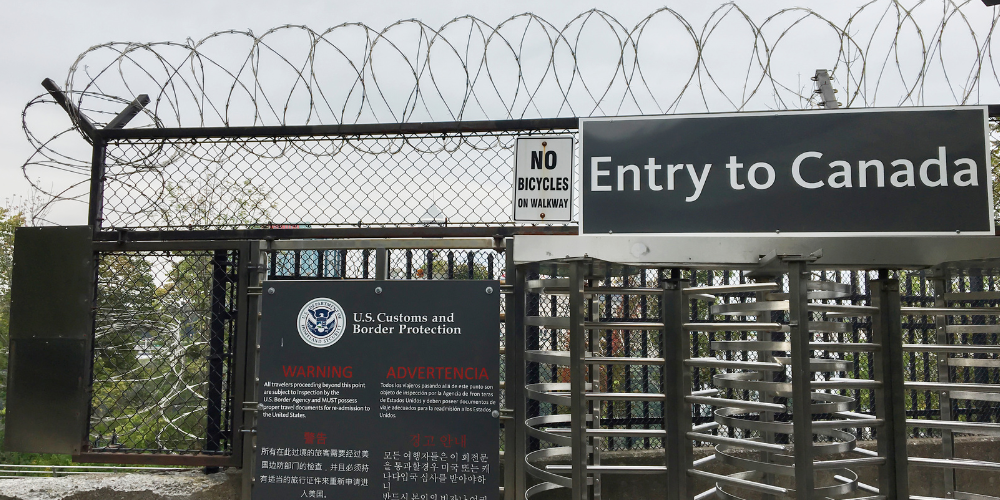
The land portion of the boundary, roughly 2,171 km of it, is marked by a continuous six-metre (20-foot) wide cleared strip called the Vista. The Vista runs through forest, prairie, and tundra alike, kept clear by the International Boundary Commission since 1908. From the air, it looks like a thin, perfectly straight scar across the landscape.
The IBC also maintains more than 8,000 monuments, obelisks, and reference markers along the line, plus over 1,000 survey control stations. Property owners adjacent to the boundary are barred from building, planting trees, or erecting structures within the Vista without IBC permission.
A quirky consequence: Derby Line, Vermont and Stanstead, Quebec share buildings that straddle the line. The Haskell Free Library has a black line painted across its reading room floor. Locals walk between countries to borrow a book.
What This Means If You’re Moving Across the Border
For most readers, the practical question is not which states border Canada but which crossing makes sense for the move you’re actually doing. A few rules of thumb:
Check Out Canada & The United States’s Bizarre Border:
- East Coast and Atlantic moves (Boston, NY metro, Philadelphia to Toronto, Montreal, or the Maritimes): Champlain-Lacolle for Montreal, Lewiston-Queenston or Peace Bridge for Toronto, Houlton-Woodstock for the Maritimes.
- Midwest moves (Chicago, Cleveland, Detroit, Pittsburgh to Toronto, Windsor, or Western Ontario): Detroit-Windsor (Ambassador or Gordie Howe) is the default.
- Plains moves (Minneapolis, Fargo to Winnipeg or Saskatoon): Pembina-Emerson on I-29.
- Mountain West moves (Denver, Salt Lake, Boise to Calgary, Edmonton, or Vancouver): Sweet Grass-Coutts for Alberta, Eastport-Kingsgate for the BC interior, Roosville for the Kootenays.
- Pacific Northwest moves (Seattle, Portland to Vancouver or Victoria): Peace Arch on I-5, or Pacific Highway for trucks; ferry options for Vancouver Island.
- Alaska moves: Alcan/Beaver Creek on the Alaska Highway, year-round.
For a commercial household-goods move, your shipper will handle the customs paperwork (Form BSF186 for personal effects), but you still need to be present at the port of entry to declare. Keep a hard-copy inventory in the car. For a guide to what comes next, see Moving to Canada From the USA.
Frequently Asked Questions
How many US states border Canada?
Thirteen: Alaska, Washington, Idaho, Montana, North Dakota, Minnesota, Michigan, Ohio, Pennsylvania, New York, Vermont, New Hampshire, and Maine. Eleven of those have land or bridge crossings into Canada. Two (Ohio and Pennsylvania) border Canada only across Lake Erie and have no road crossing of their own.
Which state has the longest border with Canada?
Alaska, by a wide margin. The Alaska-Canada border is 1,538 miles (2,475 km) long, more than twice the length of the next state (Michigan at 721 miles). Alaska accounts for roughly 28% of the total Canada-US border length.
Which state has the shortest border with Canada?
Pennsylvania, at 42 miles (68 km) of Lake Erie shoreline. Idaho is the shortest land border at 45 miles (72 km).
Does Ohio actually border Canada?
Yes, but only across Lake Erie. There is no land or bridge crossing from Ohio into Canada. The Sandusky-to-Pelee Island ferry is the only direct Ohio-Ontario passenger service, and it runs seasonally. To drive into Canada, Ohioans use the Detroit or Buffalo crossings.
How long is the Canada-US border?
The border is 8,891 km (5,525 mi) long, including 6,416 km along the contiguous 48 states and 2,475 km along Alaska. It is the longest international border in the world between two countries.
How many border crossings are there between Canada and the US?
There are 119 legal land border crossings, plus a handful of ferry services on the Pacific, Atlantic, and Great Lakes coasts. Crossing operating hours, lane types (NEXUS, FAST, commercial), and seasonal status vary widely.
Does California border Canada?
No. California is separated from Canada by Oregon and Washington. The shortest distance from the California state line to the Canadian border is about 600 miles (970 km), through Oregon.
What Canadian provinces border the US?
Eight: Yukon, British Columbia, Alberta, Saskatchewan, Manitoba, Ontario, Quebec, and New Brunswick. Ontario borders the most US states (five); British Columbia borders four. Newfoundland and Labrador, Prince Edward Island, Nova Scotia, the Northwest Territories, and Nunavut do not touch the international border.
What is the “Vista” along the border?
The Vista is a six-metre (20-foot) wide cleared strip that runs along the land portions of the Canada-US border. The International Boundary Commission has maintained it since 1908, keeping it free of trees, brush, and structures so the boundary stays physically visible.
Can I cross the border by water if I live in Ohio or Pennsylvania?
You can, but only at designated reporting points and with proper documentation. Private boaters crossing Lake Erie must report to a CBSA office or use the CBSA ROAM app to clear customs on entry. The Pelee Island ferry from Sandusky is the only scheduled passenger service from these states.
States That Border Canada: The Bottom Line
The thirteen-state answer is the right one for a trivia question, a school assignment, or a planning conversation. The eleven-state answer is the right one if you only count places where you can drive across. Both numbers describe the same border.
For anyone whose interest goes past the trivia, the practical map is simpler than the political map. There are about a dozen crossings that handle most of the traffic, three or four major bridges that move most of the freight, and a handful of remote outposts where the line cuts through wilderness. The border is the longest in the world, but most cross-border lives are anchored to a single port of entry that becomes routine.
If you’re planning the move itself, the cross-border household goods process, the immigration paperwork, and the realistic costs are covered in Moving to Canada From the USA. For the legal-status side, Migrate to Canada walks through the pathways. And before any crossing, check the CBSA Border Wait Times page so you don’t end up sitting at Pacific Highway for two hours when Peace Arch is empty.